Banks as Capital Coordinators: Nataliia Gurina on Ukraine's Financial Architecture for Recovery
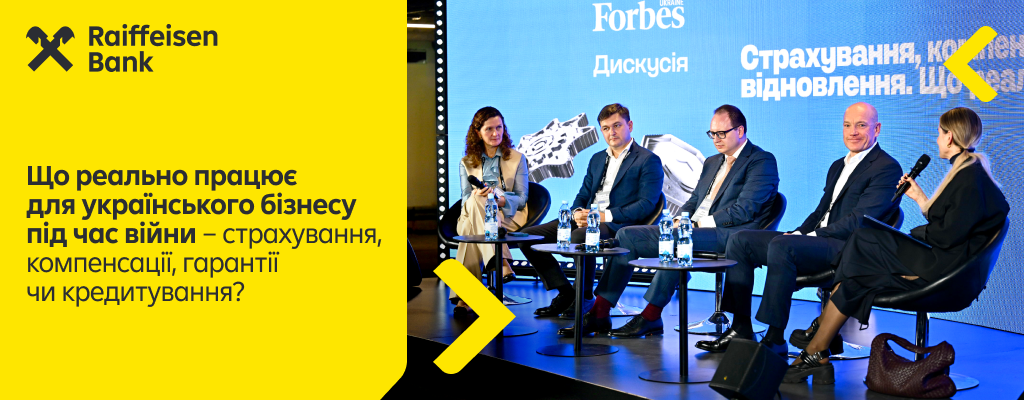
The scale of losses suffered by Ukrainian businesses is growing faster than the tools available to help entrepreneurs recover and invest. How to build a support system that moves faster than the pace of destruction was the focus of the panel "Insurance, Compensation, Recovery: What Actually Works" at the Forbes Ukraine Economic Resilience Forum.
The discussion was moderated by Nataliia Gurina, Chairwoman of the Management Board of Raiffeisen Bank. She was joined by Kristina Mikulova, Head of the EIB's Regional Representation for Eastern Europe, Tomas Fiala, CEO of Dragon Capital, Yehor Perelyhin, Deputy Minister of Economy and Environment, and Ruslan Gashev, Chairman of the Management Board of the Export Credit Agency.
Panelists conducted a public audit of the tools currently available to support business: which insurance mechanisms, compensation schemes, guarantees and financing instruments actually work, who can access them, and what needs to change for them to match the true scale of Ukrainian businesses' needs. One of the core problems: recovery isn't simply a matter of finding money. What's needed are mechanisms that allow war risk to be shared across the state, international financial institutions, insurers, banks and private investors.
Taking a broader view of the financial system's role, Nataliia Gurina argued that banks can play a far greater part than simply lending to business. Banks see their clients every day — their financial standing, their needs, their investment plans and their risks.
That is why banks are positioned to become coordinators, connecting business with international financial institutions, government programs, insurers and private capital. This isn't only about financing individual companies — it's about building an architecture capable of scaling Ukraine's economic recovery.